
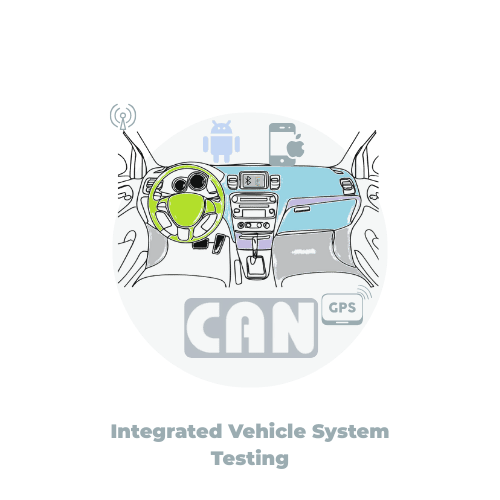
Integrated Vehicle System Testing
Complete Engine Control System Validation
From component to real-world performance
Modern vehicles are no longer mechanical systems with simple gagues — they are sophisticated digital experiences where user expectations have been shaped by smartphones. MCANTA validates complete digital experiences from the user's perspective, ensuring engineering excellence translates into customer satisfaction.
The Problem:
Engineering teams spend months perfecting ECU performance, only to discover that users are frustrated because the digital interface displays tire pressure in the wrong units, truncates foreign language text, or fails when a family connects four different phones. The technical excellence that engineering achieved becomes invisible when the digital experience doesn't meet expectations.
Key Challenge Areas:
Device Integration. Apple CarPlay and Android Auto behave differently across device generations, OS updates, and connection methods. Multi-device, mixed-platform scenarios create prioritization conflicts that never appear in single-device lab testing.
Localization. German warnings that truncate, units that don't convert between metric and imperial, characters that don't render under all lighting conditions. Online feedback forms and social media mean these failures become visible quickly and publicly.
Voice Commands. Users say "I'm cold" not "increase cabin temperature to 72 degrees." Comprehensive voice validation requires repeatable, automated execution across accents, languages, and hardware configurations.
OTA Updates. Two-week update cycles create a dual challenge: confirming new features work while ensuring nothing previously working has broken. The regression surface grows with every cycle.
Model Year Variations. A voice system that runs smoothly on this year's hardware may struggle on an older model year's CPU and memory as processing demands increase. If testing only runs on the latest hardware, degradations go undetected.
MCANTA's Approach:
MCANTA approaches vehicle validation from the user-experience perspective because that's where the gap between engineering investment and customer satisfaction actually lives. We test complete user workflows under realistic conditions — with real devices, real data, and environments that replicate the messy reality drivers encounter every day.
Ready to ensure your engineering excellence translates into exceptional user experience? Contact MCANTA to discover how digital experience validation can bridge the gap between technically perfect systems and genuinely satisfied customers.
Not sure where to start? Our Proof of Value assessment lets you experience our methodology on a specific challenge before any major commitment. Your engineering deserves validation that matches its quality. Contact us to see how our Vehicle Last Mile Labs can give your team the answers it needs.

System Stability
Ensure system stability and usability with varied scenarios and long execution times. Focus improvement efforts on bottlenecks for high-impact customer facing issues.

Enhanced User Experience
Identify potential bottlenecks and UX problems pre-release. Deliver a seamless, satisfying user experience by resolving issues in advance.

Improved Decision-Making
Rely on dependable insights for effective decision-making, streamlining operations, and optimizing performance.

Scalability
Our services adapt to your project needs and schedule. Scale resources for peak periods or periodic releases, ensuring continuous support for your goals.
Why Integrated Vehicle Testing Matters
Component-level testing validates that ECU systems meet engineering specifications, but it cannot predict user satisfaction. A tire pressure monitoring system may report pressure values with perfect accuracy, but if the interface displays readings in unfamiliar units or requires multiple menu navigation steps to access, users will perceive the system as defective.
MCANTA's digital experience validation eliminates the gap between technical excellence and user satisfaction. We test complete user workflows under realistic conditions, ensuring that the engineering excellence of ECU systems translates into positive user experiences.
The systematic approach reveals interface problems before production deployment, when correction costs remain manageable. More importantly, it ensures that the substantial engineering investment in ECU development delivers the user experience that determines vehicle satisfaction and brand loyalty.